

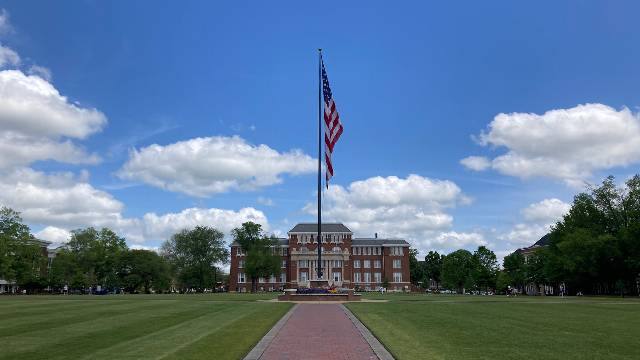
 Agricultural Autonomy Institute joins Harper Adams University's 125th anniversary celebrations
A leading American expert in agricultural autonomy has paid tribute to Harper Adams University as it marks its 125th anniversary.Dr Alex Tho …
Posted 22 October
Finding more sustainable options for microbial inoculation at sowing of winter wheat
16 February 2023

A final year student is focusing her Honours Research Project (HRP) on the effect of different application methods of microbial inoculant on the establishment and growth of winter wheat.
Lily Butters, 21, from Norfolk had grown up surrounded by farming and knew, whilst at college, that her end goal was to study Agriculture with Crops at Harper.
Fast-forward to now, she explains in this article how new science could provide a more sustainable method of protecting the seed in the soil.
I am currently completing my fourth year at Harper Adams, studying BSc (Hons) Agriculture with Crop Management. Following my placement year with agricultural research and development company ADAS, in Hereford, where I was involved in crop trials, I was keen to conduct a glasshouse-based trial for my Honours Research Project.
With a keen interest in sustainable agriculture, inspired by my modules at Harper Adams, and a curiosity about the evolving topic of regenerative farming, I decided I would like to complete my HRP in this area. I have been fortunate enough to be offered the opportunity to work alongside a local Hutchinson’s Helix farmer, Harry Heath, who owns a large farming enterprise, recently dedicated to regenerative studies just a short distance from campus.
The main focus of my HRP is looking at microbial inoculation at sowing of winter wheat, using a system called a Johnson-Su Bioreactor, which creates a composted mixture, rich in microbes, that can be used as an alternative to conventional chemical seed dressings to protect the seed in its early stages of growth. The technology, invented by David Johnson, at the Centre for Regenerative Agriculture in California has recently been introduced in the UK and only taken on by a few farmers. This is mainly because it is a fairly untested method – the benefits are not widely known, and there are many questions still surrounding the best methods for application, rates and timings.
The aim of my HRP will be to compare the effect of different application methods of the microbial inoculant to winter wheat seed on subsequent crop establishment and growth. I am conducting a glass house-based pot trial in the facilities at Harper, where I will be using different rates of the Johnson-Su composted mixture, and either applying it directly to the soil before sowing (described as in-furrow treatment), or drenching wheat seed in the mixture, then sowing into pots. The experiment also includes an untreated control. The objective is to determine whether an in-furrow application or seed drenching application is likely to have more of an impact on the establishment and growth of winter wheat in a commercial farm setting.
The application of this new technology will help farmers who are looking to move towards a more regenerative based system, whilst protecting the final yield of the crop by building up the microbiology in the soil to protect the longevity of farming for many more years.
My HRP will allow me to be a part of cutting-edge research, while giving me the practical skills of running trials, data analysis and interpretation, with the aim to provide me with life-long skills that will help me in my aim to pursue a career in sustainable agriculture.
Related Posts
Agricultural Autonomy Institute joins Harper Adams University's 125th anniversary celebrations
A leading American expert in agricultural autonomy has paid tribute to Harper Adams University as it marks its 125th anniversary.Dr Alex Tho …
Posted 22 October
 Sky's the limit: Helen joins MP's fundraising parachute jump
A charity skydive by a Harper Adams University Business Development Consultant has helped raise more than £16,000 for a new cancer cen …
Posted 21 October
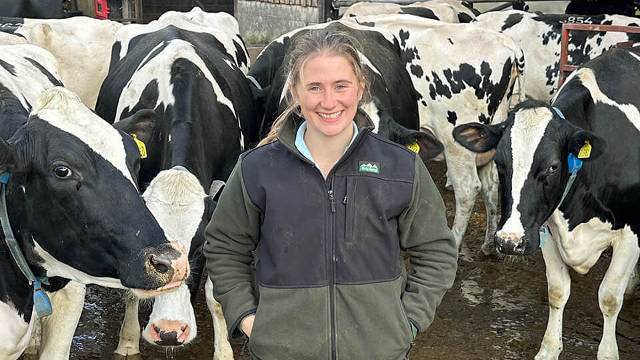 From dairy farm - to farm vet
Growing up on a dairy farm played a huge part in shaping Harriet Brimacombe’s ambition to become a vet. Now, as she prepares to …
Posted 20 October
 Listen: Archers anniversary marked with future of farming discussion on BBC radio
With BBC Radio Four marking the 75th anniversary of the Archers this year, Farming Today has taken the opportunity to look forwards this wee …
Posted 16 October